Paul Keller · 11 September 2026
Integration Challenges in Evolving Digital Ecosystems: A Case Study Approach
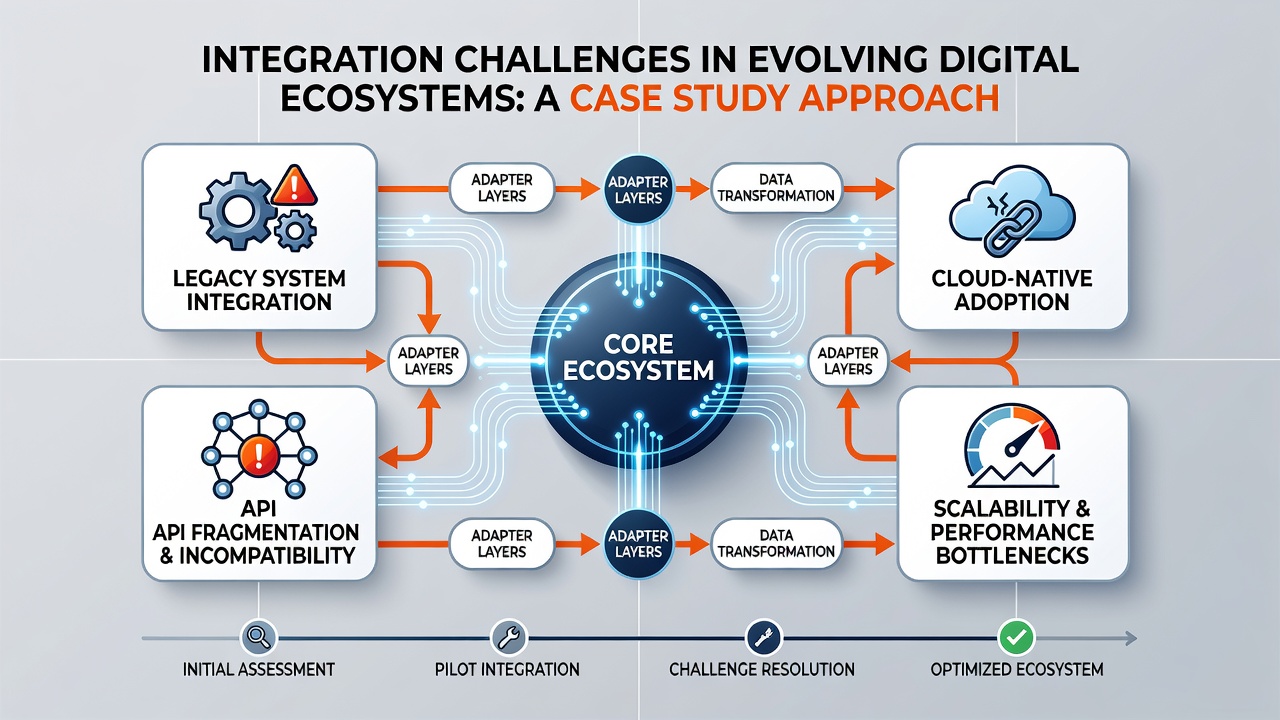
Digital ecosystems continue to expand as organizations connect platforms, data sources, and third-party services to support operations across industries, yet integration remains a persistent point of friction that requires coordinated technical and organizational responses. Research from government agencies and academic institutions shows that legacy systems, data incompatibility, and security protocols often create bottlenecks when new components enter existing networks.
Core Technical Barriers in System Connectivity
Observers note that application programming interfaces frequently fail to align across vendors because each provider maintains distinct data formats and authentication methods, which forces teams to build custom middleware that adds maintenance overhead over time. Studies from the National Institute of Standards and Technology highlight how inconsistent encryption standards between cloud providers and on-premises databases increase exposure to unauthorized access during data transfers.
Scalability testing conducted by research groups reveals that sudden spikes in user demand expose weak points in orchestration layers, where containerized services lose synchronization and produce inconsistent transaction records. Those who manage large-scale deployments report that monitoring tools must track latency across dozens of microservices simultaneously, otherwise performance degradation spreads before teams can isolate the source.
Case Study: Healthcare Platform Consolidation
One multi-hospital network attempted to merge electronic health record systems from three separate vendors into a unified patient portal, yet differing patient identifier schemas prevented automatic record matching. Staff discovered that manual reconciliation consumed thousands of hours each quarter while regulatory compliance deadlines approached. Data from the European Commission on digital health initiatives indicates similar patterns across member states where cross-border data exchange standards remain only partially implemented.
Security teams within the network found that role-based access controls did not translate cleanly between the legacy and new platforms, resulting in temporary over-privileging of certain user groups until new policies could be coded and tested. The project timeline extended by nine months as engineers reworked identity federation layers to satisfy both internal governance and external audit requirements.
Case Study: Manufacturing Supply Chain Modernization
A global automotive supplier introduced Internet of Things sensors across assembly lines and connected them to an enterprise resource planning platform that had operated unchanged for fifteen years. Initial data streams arrived in incompatible time-stamp formats, which disrupted inventory forecasting models and created discrepancies between actual component counts and recorded stock levels. Reports from the Organisation for Economic Co-operation and Development on industrial digitalization note that such mismatches appear regularly when older operational technology meets newer information technology stacks.
Engineers introduced an intermediate data normalization service that translated sensor outputs into the ERP schema, yet this layer introduced additional latency that affected real-time quality control alerts. Production supervisors observed that alerts arrived several seconds late during high-speed runs, prompting a second round of optimization focused on edge processing to reduce round-trip delays.
Regulatory and Organizational Dimensions Emerging in 2026
By September 2026, updates to cross-border data transfer frameworks in multiple jurisdictions are scheduled to require explicit documentation of every integration point that handles personal or operational data. Organizations preparing for these changes have begun mapping data lineage across all connected applications, a process that surfaces previously undocumented shadow IT systems. Academic papers published in 2025 already documented how incomplete mapping correlates with higher rates of compliance findings during external audits.
Industry associations tracking digital transformation metrics report that companies allocating dedicated integration governance teams achieve faster resolution of cross-platform conflicts than those relying solely on project-based task forces. The distinction appears most clearly in metrics tracking mean time to restore service after an integration-related outage.
Observed Approaches to Reducing Friction
Teams that adopt standardized data exchange protocols early in project planning reduce later rework, according to case analyses from Canadian research institutes studying public sector digitization. API gateways equipped with built-in schema validation catch format mismatches before they reach downstream systems, cutting troubleshooting time in documented deployments. Some organizations implement staged rollouts where new connections operate in read-only mode for an initial period, allowing performance baselines to stabilize before write operations activate.
Training programs that combine technical documentation with cross-team workshops help surface organizational assumptions about data ownership that technical tools alone cannot resolve. Those who have participated in such programs note that clearer escalation paths shorten the time required to obtain approvals for changes that affect multiple business units.
Conclusion
Integration challenges in digital ecosystems arise from the intersection of technical incompatibility, security requirements, and evolving regulatory expectations, as illustrated by the healthcare and manufacturing examples. Continued observation of deployments through 2026 and beyond will show whether standardized protocols and dedicated governance structures produce measurable reductions in integration-related incidents across sectors. Data collected by regulatory bodies and research institutions will provide further evidence on which practices scale effectively when ecosystem complexity increases.